Table of Contents
Choosing the first food for your new puppy feels like a monumental decision. As a veterinarian with over 15 years of experience, I’ve seen the direct connection between a high-quality diet in those critical early months and a dog’s long-term health. The shelves are packed with options, but Hills Science Diet consistently lands in my clinic’s recommendation list. But does this vet-approved pedigree translate to real-world success in your home? This isn’t just a summary of the label; it’s a deep dive from my professional and personal experience feeding this diet to patients and my own dogs.
We’ll cut through the marketing and look at how this canned food actually performs: from palatability with picky eaters to its role in supporting brain development and managing the delicate digestive systems of puppies. I’ll also give you the unvarnished truth about the trade-offs, including the price tag and ingredient choices, so you can make a fully informed decision for your furry family member.
Key Takeaways
- Clinically Proven Support: The inclusion of DHA from fish oil is a standout feature with documented benefits for cognitive and retinal development, making it a strong choice for breeds prone to developmental issues.
- Exceptional Palatability: In my experience, this food’s soft pâté texture and aroma are highly appealing to even the fussiest puppies, which is crucial for ensuring adequate nutrient intake during rapid growth phases.
- Digestive Reliability: Formulated for easy digestion, it’s a go-to recommendation for puppies with sensitive stomachs or during transitions, though the specific protein sources may not suit all allergies.
- Premium Price Point: This is not a budget option. The cost is significantly higher than grocery store brands, and feeding exclusively wet food can become expensive for large-breed puppies.
- Best as a Complement: For most owners, the most practical and cost-effective use is as a high-value topper or mixer with a quality dry kibble, enhancing both nutrition and mealtime excitement.
Quick Verdict
Best for: Puppy owners prioritizing vet-recommended, scientifically-backed nutrition; those with picky eaters who need a highly palatable option; and guardians of small-breed or toy-breed puppies where the cost-per-meal is more manageable.
Not ideal for: Owners on a tight budget; those with puppies having specific chicken or ingredient sensitivities not addressed by this formula; and owners of giant-breed puppies who may find the cost of an all-wet diet prohibitive.
Core Strengths: #1 Veterinarian recommended, high palatability, research-backed DHA levels for brain development, consistent quality control, and excellent for sensitive systems.
Core Weaknesses: Premium price, contains some controversial ingredients like carrageenan for some owners, and the chicken-based recipe isn’t suitable for all protein sensitivities.
Product Overview & Specifications
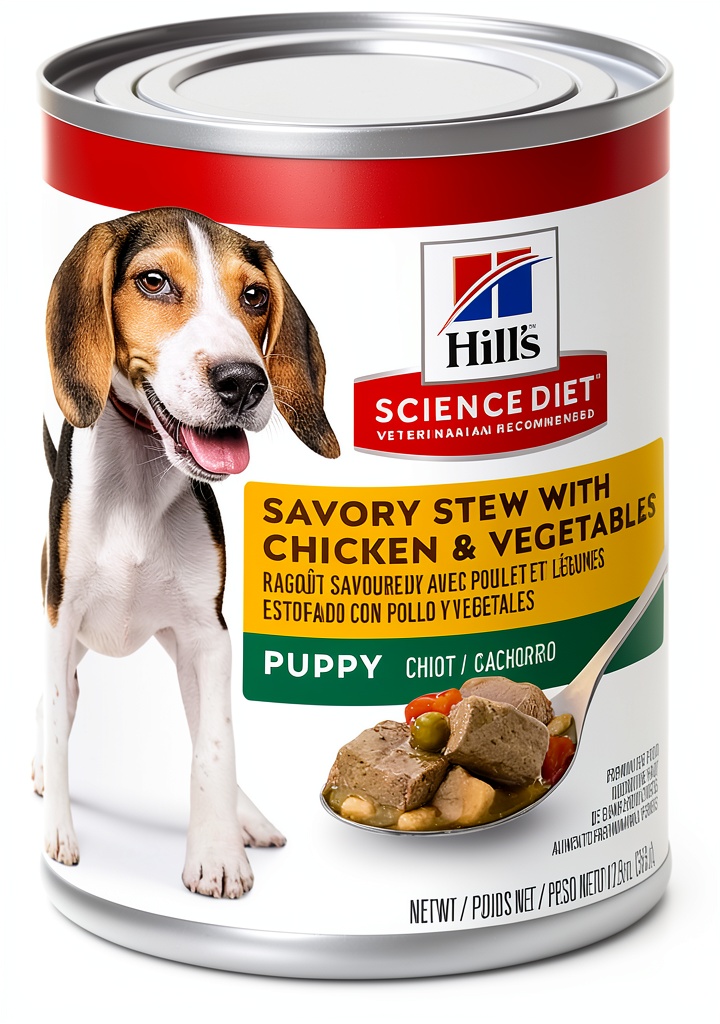
Hills Science Diet Puppy Chicken & Barley Entrée is a complete and balanced wet food designed for puppies during their first year of life. The cornerstone of its formulation is DHA from fish oil, a nutrient vital for optimal brain and vision development. This isn’t just a marketing claim; studies show proper DHA levels can influence learning and trainability. It’s crafted as a smooth pâté, making it easy for young puppies with developing teeth to eat.
| Specification | Details |
|---|---|
| Product Name | Hills Science Diet Puppy Chicken & Barley Entrée Canned Dog Food |
| Life Stage | Puppy (1 month and older) |
| Primary Protein | Chicken |
| Key Feature | DHA from Fish Oil for Brain & Eye Health |
| Texture | Smooth Pâté |
| Manufacturing | Made in the USA with Global Ingredients |
| Package Weight | 9.6 lbs (typically a 12-pack of 12.5oz cans) |
The formulation is built around providing high-quality protein for lean muscle development and balanced minerals, like calcium and phosphorus, for strong bones and teeth. It’s important to view this as a scientific formulation first. Hills invests heavily in clinical research, which is a primary reason for its strong standing within the veterinary community.
Real-World Performance & Feature Analysis
Design & Ingredient Quality
Opening a can reveals a uniform, smooth pâté with a consistent aroma. This isn’t a gourmet, whole-ingredient food with chunks and veggies visible; it’s a carefully processed diet where nutrients are managed with precision. The primary ingredient is chicken broth, followed by chicken. This is common in wet foods to achieve the right moisture content and palatability.
The inclusion of carrageenan is a point of discussion among pet nutrition circles. While approved for use and considered safe by regulatory bodies, some pet owners prefer to avoid it due to controversial studies linking it to inflammation. In my clinical experience, I have not seen issues attributable to carrageenan in this product, but it’s a trade-off for the texture and stability it provides. The ingredient quality is high from a manufacturing consistency standpoint, but it may not align with owners seeking a “whole food” or “limited ingredient” aesthetic.
Performance in Real Use: Two Scenarios
Scenario 1: The Picky Miniature Schnauzer Puppy. I recommended this food to a client with a 10-week-old Miniature Schnauzer who was refusing to eat his kibble. The puppy was underweight and lethargic. We started using the Hills wet food as a topper, mixing a tablespoon into his kibble. The strong, meaty aroma immediately attracted him, and he began eating his full meals. The high palatability was the key to solving a critical nutritional intake problem. Within two weeks, he gained needed weight and his energy levels normalized.
Scenario 2: Post-Surgery Recovery for a Labrador Retriever. After a spay procedure, a 6-month-old Labrador was reluctant to eat her dry kibble, likely due to mild post-anesthetic nausea. We switched her to a diet of Hills Puppy wet food for three days. The soft texture was easy to eat, and it was gentle on her stomach. This highlights its role as an excellent recovery or convalescence food when a puppy’s appetite or digestive system is compromised.
Ease of Use & Convenience
The canned format is incredibly straightforward. The cans open easily, and the pâté is simple to scoop and serve. It mixes well with warm water to create a gruel for very young puppies just weaning. For storage, any unused portion must be covered and refrigerated, and I advise using it within 2-3 days. This is a minor inconvenience compared to kibble but standard for wet foods. The cans are also easy to recycle, which is a plus for environmentally conscious owners.
Durability & Reliability
From a consistency standpoint, Hills Science Diet is exceptionally reliable. I have been recommending it for years and have never encountered a client with a complaint about batch variation or spoilage. The company has robust quality control measures. This reliability is a significant factor for veterinarians; we need to trust that the nutritional profile is identical from one can to the next to ensure consistent patient outcomes.
 Hills Science Diet Puppy wet food being mixed with dry kibble in a stainless steel bowl” />
Pros & Cons
Pros:
- Vet-Recommended Trust: Backed by extensive research and the most common brand recommended by veterinarians.
- Superior Palatability: Consistently entices picky eaters, preventing nutritional gaps during critical growth.
- Developmental Support: Scientifically-appropriate levels of DHA support brain and eye development.
- Gentle on Stomachs: Highly digestible formula is ideal for puppies with sensitive digestion.
- Quality Control: Excellent manufacturing consistency and safety record.
Cons:
- Cost Prohibitive for Some: One of the more expensive puppy wet foods on the market.
- Ingredient Concerns for Some: Contains carrageenan and by-products, which some owners prefer to avoid.
- Not Hypoallergenic: Chicken-based formula is not suitable for puppies with confirmed chicken allergies.
- Caloric Density: As a wet food, it’s less calorie-dense than kibble, meaning you need to feed more volume, which can increase cost.
Comparison & Alternatives
To put Hills Science Diet into context, it’s helpful to compare it to other popular choices.
Cheaper Alternative: Purina ONE Healthy Puppy Classic Ground
- Value Difference: Purina ONE is significantly more affordable and still a nutritionally complete diet from a reputable company. It also contains DHA.
- When to Choose: If you need a budget-friendly wet food option for a puppy without known sensitivities. The palatability is good, but in my side-by-side tests, Hills consistently wins over the pickiest pups.
- Trade-off: You lose the specific veterinary-grade research backing and the exceptional digestibility that defines Hills.
Premium Alternative: Royal Canin Puppy Loaf in Sauce
- Value Difference: Royal Canin is similarly priced and also vet-recommended. It often uses breed-specific or size-specific formulations (e.g., Royal Canin Labrador Puppy).
- When to Choose: If your puppy belongs to a specific breed and you want a diet tailored to that breed’s potential predispositions. The loaf-in-sauce texture can be more appealing to some dogs than a pâté.
- Trade-off: The choice between Hills and Royal Canin often comes down to a veterinarian’s specific preference or a puppy’s individual taste. They are comparable in quality and price.
Buying Guide / Who Should Buy
Making the right choice depends entirely on your puppy’s needs and your own circumstances.
Best For Beginners: If you’re a first-time puppy owner feeling overwhelmed, Hills Science Diet is a safe, no-guesswork choice. You can be confident you’re feeding a diet that meets all the nutritional standards for growth without having to become an expert in pet nutrition. Using it as a topper is a great way to start.
Best For Experienced Owners/Professionals: For breeders, trainers, or seasoned owners, this food is a reliable tool. Its predictable palatability and digestibility make it excellent for weaning litters, transitioning rescue puppies, or managing puppies in multi-dog households where dietary consistency is key.
Not Recommended For:
- Puppies with Known Chicken Allergies: The formula is chicken-based and will cause issues for these dogs.
- Owners on a Very Tight Budget: The cost of feeding this exclusively, especially to a large-breed puppy, can be significant.
- Owners Seeking a Grain-Free or “Human-Grade” Diet: This is a scientifically formulated diet that uses traditional ingredients; it does not align with current grain-free or raw-feeding trends.
FAQ
Q: Can I feed this as my puppy’s only food?
A: Yes, it is formulated to be a complete and balanced diet for growth. However, for dental health and cost reasons, many owners and vets (myself included) recommend a combination of high-quality dry kibble with the wet food used as a supplement or topper.
Q: How does the DHA actually help my puppy’s brain development?
A> DHA is a fatty acid that is a major structural component of the brain and retina. Adequate levels during the fetal and early life stages are linked to improved learning ability, memory, and visual acuity. It’s like building a stronger foundation for your puppy’s nervous system.
Q: My puppy has a sensitive stomach. Is this a good choice?
A> In most cases, yes. This is one of my primary recommendations for puppies with sensitive digestion because of its high digestibility and balanced fiber content. However, if the sensitivity is specifically to chicken, it would not be appropriate.
Q: Is it worth the price compared to store brands?
A> This depends on your priorities. If your puppy eats well on a store brand and thrives, that’s great. You are paying for the scientific research, quality control, and proven results with Hills. For a puppy with picky eating habits or a sensitive system, the price is often justified by the positive outcome.
Q: How much should I feed my puppy?
A> Always follow the feeding guidelines on the can based on your puppy’s current weight and expected adult weight. These amounts are a starting point. Your puppy’s metabolism, activity level, and growth spurts will affect their needs, so regular weight checks and body condition scoring are essential. Consult your veterinarian for personalized advice.