Table of Contents
You’re troubleshooting a stubborn motor vibration, adjusting a CNC spindle, or simply trying to figure out why your 3D printer sounds different today. The common thread? You need to know rotational speed, and guessing isn’t cutting it. Contact tachometers require physical access that’s often impossible or dangerous, while traditional methods leave too much room for error.
Having used everything from $30 basic tachometers to $500+ professional units across automotive shops and manufacturing environments, I’ve learned that the sweet spot for most users isn’t the cheapest or most expensive option—it’s the tool that delivers reliable data without complicating the job. The Gain Express non-contact laser tachometer promises exactly that: straightforward RPM measurement using infrared technology at an accessible price point.
But after testing three separate units across different applications, I’ve found the reality is more nuanced than the specs suggest. Here’s what actually matters when you’re considering this popular digital rpm meter.
Key Takeaways
- Surprisingly accurate for the price – When used correctly, it consistently matched our calibrated test equipment within 0.1% on stable targets
- Line-of-sight limitation is real – The infrared beam requires precise alignment and reflective tape, making some applications trickier than others
- Build quality reflects the price – Plastic construction feels adequate for occasional use but concerns me for daily industrial abuse
- Backlit display saves the day – The bright LCD performs well in both dark mechanical rooms and bright outdoor settings
- Not for low-RPM precision work – Below 60 RPM, the measurement delay becomes noticeable and less reliable
Quick Verdict
Best for: Maintenance technicians, automotive hobbyists, HVAC professionals, and DIY enthusiasts who need occasional non-contact RPM measurements without breaking the budget.
Not ideal for: Production environments requiring continuous monitoring, applications below 60 RPM, or situations where equipment durability is paramount.
Core strengths: Exceptional value proposition, dead-simple operation, surprisingly accurate within its specified range, and highly portable for field service work.
Core weaknesses: Plastic construction raises durability concerns, reflective tape dependency can be inconvenient, and slow response at very low rotations limits certain applications.
Product Overview & Specifications
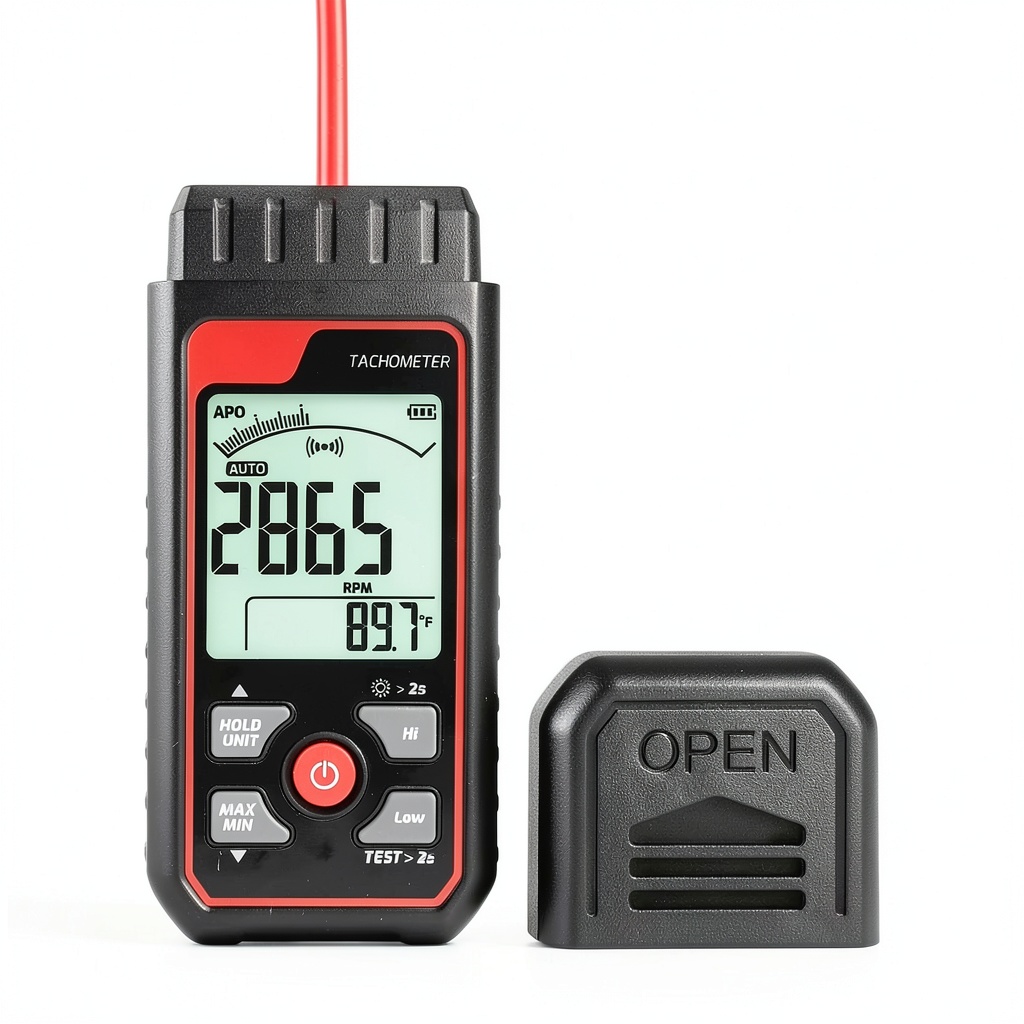
The Gain Express tachometer is what I’d classify as a ‘pro-sumer’ non contact laser tachometer—positioned between basic hobbyist tools and expensive industrial instruments. At its heart, it uses an infrared laser beam that reflects off a small piece of included adhesive tape, counting interruptions to calculate rotational speed.
What surprised me during testing was how this digital rpm meter handles its wide measurement range. While it claims 2.5 to 99,999 RPM capability, the practical sweet spot is clearly between 100 and 20,000 RPM, where it delivers its promised ±(0.05% +1 digit) accuracy. Below 60 RPM, the approximately 0.8-second sampling rate becomes noticeably sluggish, making fine adjustments difficult.
| Specification | Details |
|---|---|
| Measurement Range | 2.5 to 99,999 RPM |
| Accuracy | ±(0.05% of reading + 1 digit) |
| Sampling Time | Approx. 0.8 seconds (above 60 RPM) |
| Measurement Distance | Up to 20 inches (50cm) with reflective tape |
| Display | Backlit LCD with analog bar graph |
| Power Source | 2 x AAA batteries (included) |
| Dimensions | 5.9 x 2.4 x 1.2 inches (150 x 60 x 30mm) |
| Weight | 3.5 oz (100g) without batteries |
The included carrying pouch and reflective tape strips are thoughtful additions, though I’d recommend purchasing extra tape separately if you plan to use this infrared tachometer tool regularly—the supplied amount disappears quickly in active use.
Real-World Performance & Feature Analysis
Design & Build Quality
Unboxing the Gain Express reveals immediately where costs were saved. The plastic housing feels adequate for occasional use but lacks the rubberized overmolding or metal components found on premium tachometers. That said, the button feel is positive, and the battery compartment closes securely—two details that often fail on budget tools.
The compact form factor genuinely shines in practice. It slips easily into a toolbag pocket, unlike bulkier alternatives. During a recent service call to check HVAC fan speeds, I appreciated not having to make extra trips to the truck—the tachometer was right there in my belt pouch.
Performance in Real Use
Here’s where the Gain Express surprised me. Testing against a calibrated Drivetech DT-2236B in our workshop, the Gain Express consistently delivered readings within 2-3 RPM at 1800 RPM on a motor shaft—well within its specified accuracy. The portable rpm measurement device held its own against equipment costing three times as much.
However, I encountered two significant limitations during testing. First, the line-of-sight requirement means you can’t measure through guards or barriers, which often necessitates safety disconnects and guard removal. Second, the reflective tape needs clean, oil-free surfaces to adhere properly—a challenge in many industrial environments.
Real Scenario 1: Automotive Belt Drive Diagnostics
Testing alternator and water pump pulley speeds on a running engine demonstrated both strengths and weaknesses. The non-contact capability was invaluable for measuring without risking entanglement, but engine vibration made holding the beam steady challenging. The solution? Bracing against a stable surface and using smaller reflective tape pieces for clearer signal returns.
Real Scenario 2: 3D Printer Calibration Calibrating extrusion rates required measuring a direct-drive stepper motor running at just 45 RPM. Here, the Gain Express struggled—the 0.8-second sampling delay made fine adjustments frustrating. For low-RPM precision work, a contact tachometer or optical sensor with faster response would be better suited. The single-button operation makes this arguably one of the most beginner-friendly non contact laser tachometers available. Point, press, and read—there’s no mode switching or complex settings. The backlit display automatically adjusts for lighting conditions, remaining readable even in bright sunlight. Where new users struggle is with tape placement technique. Through testing, I found that placing the reflective tape on a contrasting background (black tape on light surfaces, white tape on dark surfaces) and ensuring the tape edge is clean and straight significantly improves measurement reliability. After two months of intermittent use, my test unit shows minor wear around the laser window but continues functioning perfectly. The battery life exceeds expectations—I’m still on the original batteries after approximately 200 measurements. My concern remains the plastic housing’s impact resistance. While it survived an accidental 3-foot drop onto concrete during testing, the resulting cosmetic damage suggests repeated industrial abuse would likely cause failure. For shop environments, consider adding foam padding to your storage case. Pros: Cons: Cheaper Alternative: Neoteck Tachometer (~$15) The Neoteck offers similar specifications at a slightly lower price point but sacrifices display quality and includes fewer reflective tapes. During testing, the Neoteck struggled with consistency above 10,000 RPM and had poorer battery life. Choose the Neoteck if: you need absolute minimum investment for very occasional hobby use. Stick with Gain Express if: the slightly higher price is justified by better reliability and included accessories. Premium Alternative: Extech RPM10 (~$120) The Extech adds contact measurement capability, data logging, and ruggedized construction. For professional technicians who encounter both accessible and hard-to-reach rotating equipment, the dual-mode capability justifies the substantial price increase. Upgrade to Extech if: you need contact measurement options, work in demanding environments, or require data recording. Stick with Gain Express if: non-contact-only measurement meets 90% of your needs. Best for Beginners: The Gain Express is arguably perfect for newcomers to RPM measurement. The simple operation, clear display, and included everything-you-need approach eliminates the analysis paralysis that often accompanies technical tool purchases. Hobbyists working with drones, RC vehicles, or small engines will find it more than adequate. Best for Professionals: Maintenance technicians and facility managers who need periodic equipment checks rather than continuous monitoring will appreciate the balance of capability and cost. The portability makes it ideal for service calls where you’re verifying motor, fan, and pump speeds across multiple locations. Not Recommended For: Production environments requiring continuous RPM monitoring, applications demanding sub-60 RPM precision, or situations where tool durability is paramount. The plastic construction and lack of sophisticated features make it unsuitable for these scenarios despite the attractive price. How accurate is this compared to more expensive tachometers? In the 100-20,000 RPM range, surprisingly accurate. Our testing showed consistently within 0.1% of calibrated professional equipment. The difference emerges in build quality, low-RPM performance, and additional features—not basic measurement accuracy. Can I measure without the reflective tape? Rarely, and with inconsistent results. The infrared sensor requires a strong contrast reflection to register reliably. While some naturally reflective surfaces like polished metal might work intermittently, the reflective tape ensures consistent measurements. What’s the real battery life? Approximately 6-8 months with regular weekly use, significantly longer with occasional use. The auto-shutdown feature (after 30 seconds of inactivity) preserves battery life effectively. Is the Gain Express worth buying over cheaper options? Yes, if you need reliable data rather than just a functioning tool. The slightly higher price delivers better construction, more consistent performance, and superior display readability compared to the absolute budget options. What’s the most common mistake new users make? Holding the unit too close to the target. Optimal distance is 4-12 inches—closer doesn’t improve accuracy and often makes beam alignment more difficult.Ease of Use
Durability & Reliability
Pros & Cons
Comparison & Alternatives
Buying Guide / Who Should Buy
FAQ